
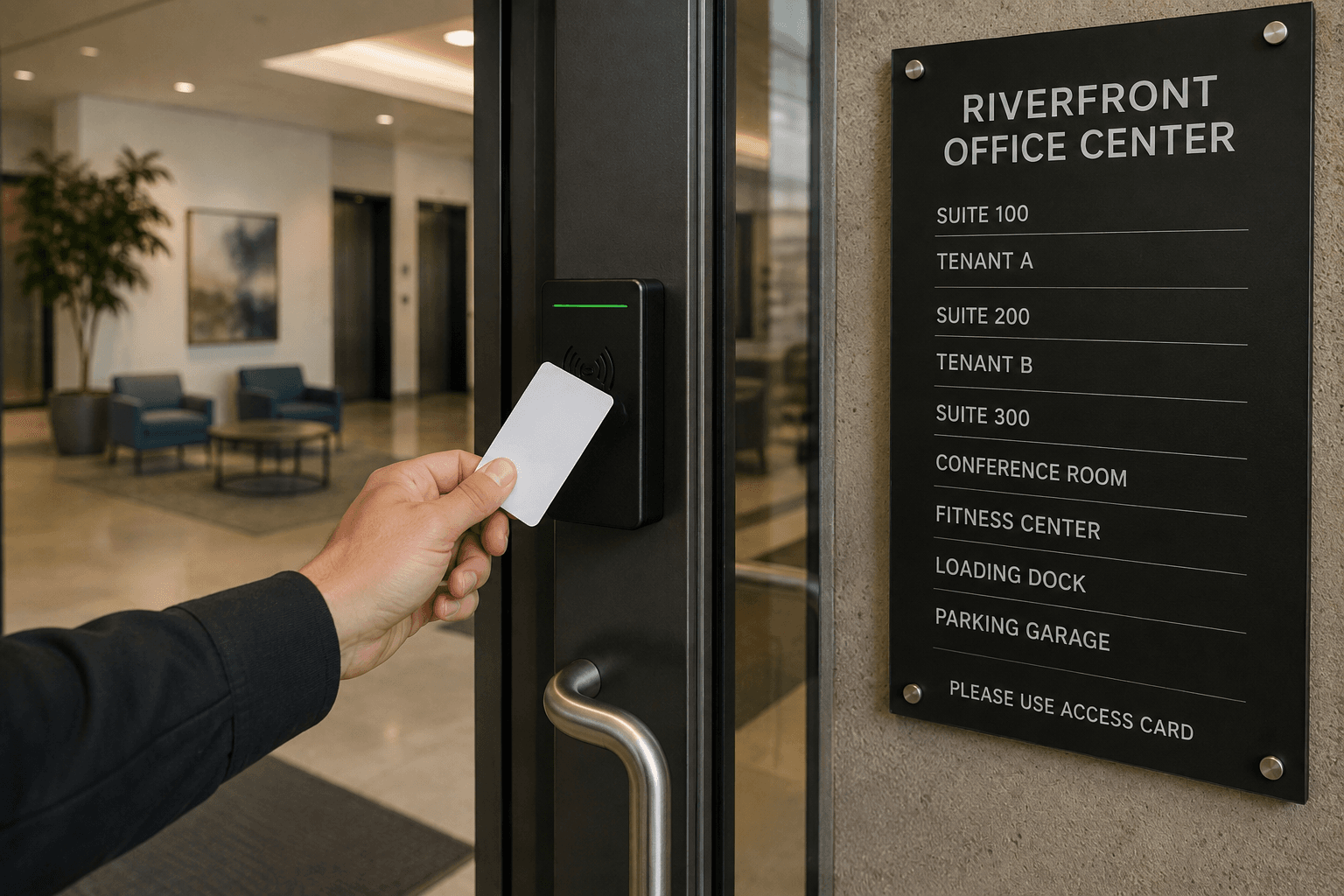
Access control installation for a multi-tenant or office property in Modesto typically means credentialed entry at the building's main entrance plus individually managed access to tenant suites, shared amenities, and restricted areas — giving property management a single audit trail instead of a set of mechanical keys that are difficult to track or revoke.
The Problem with Mechanical Keys in Multi-Tenant Buildings
Traditional lock-and-key systems create an ongoing liability for property managers: keys get copied, lost, or never returned when a tenant moves out or an employee leaves, and re-keying every affected lock after a security concern is expensive and disruptive. An access control system replaces that with electronic credentials — badges, fobs, or mobile credentials — that can be issued or revoked instantly from a management platform, without touching a single lock cylinder.
What Access Control Looks Like in a Multi-Tenant Property
- Main entrance and common areas — credentialed access for all tenants and visitors, with a full log of entry activity.
- Individual tenant suites — access limited to that tenant's employees, managed independently of other suites in the building.
- Shared amenities — conference rooms, loading docks, and parking structures scoped to specific credential groups and time windows.
- After-hours restrictions — access schedules that automatically lock down common areas outside business hours.
More detail is on our access control services page.
Why Property Managers Choose Access Control Over Traditional Locks
Beyond the security benefit, access control gives property management a documented history of who entered which space and when — useful for resolving disputes, verifying maintenance visits, and demonstrating due diligence after an incident. When a tenant's lease ends, their credentials are simply deactivated rather than requiring a physical lock change, which keeps ongoing operational costs down across a multi-tenant portfolio.
Integration with Building-Wide Systems
In many Modesto office and multi-tenant buildings, access control is paired with video surveillance at entry points, so a badge event and the corresponding camera footage are tied together automatically. That combination gives property management verification, not just a log entry, when an access event needs to be reviewed.
Planning an Installation Around an Existing Building
Retrofitting access control into an occupied multi-tenant building is different from wiring a new construction project — existing doors, tenant schedules, and ongoing operations all have to be worked around. A property walkthrough with an experienced integrator identifies which doors need hardware, how tenant suites should be grouped, and how to phase installation with minimal disruption to tenants. Our why choose us page covers how our team approaches projects like this.
FAQ
Can access control be added to an occupied building without disrupting tenants?
Yes — installation is typically phased door by door, scheduled around tenant operations, so the building doesn't need to close or clear out during the project.
What happens when a tenant moves out?
Their credentials are deactivated from the management platform, eliminating the need for a physical lock change or re-keying.
Can different tenants have different levels of access in the same building?
Yes — access is typically scoped by credential group, so each tenant's employees only have access to their suite and the common areas they're authorized to use.
Does access control work with existing building doors and hardware?
In most cases, existing doors can be retrofitted with access control hardware, though a site walkthrough determines what's compatible and what may need replacement.
Managing a multi-tenant or office property in Modesto? Get a Custom Security Quote for building-wide access control.