
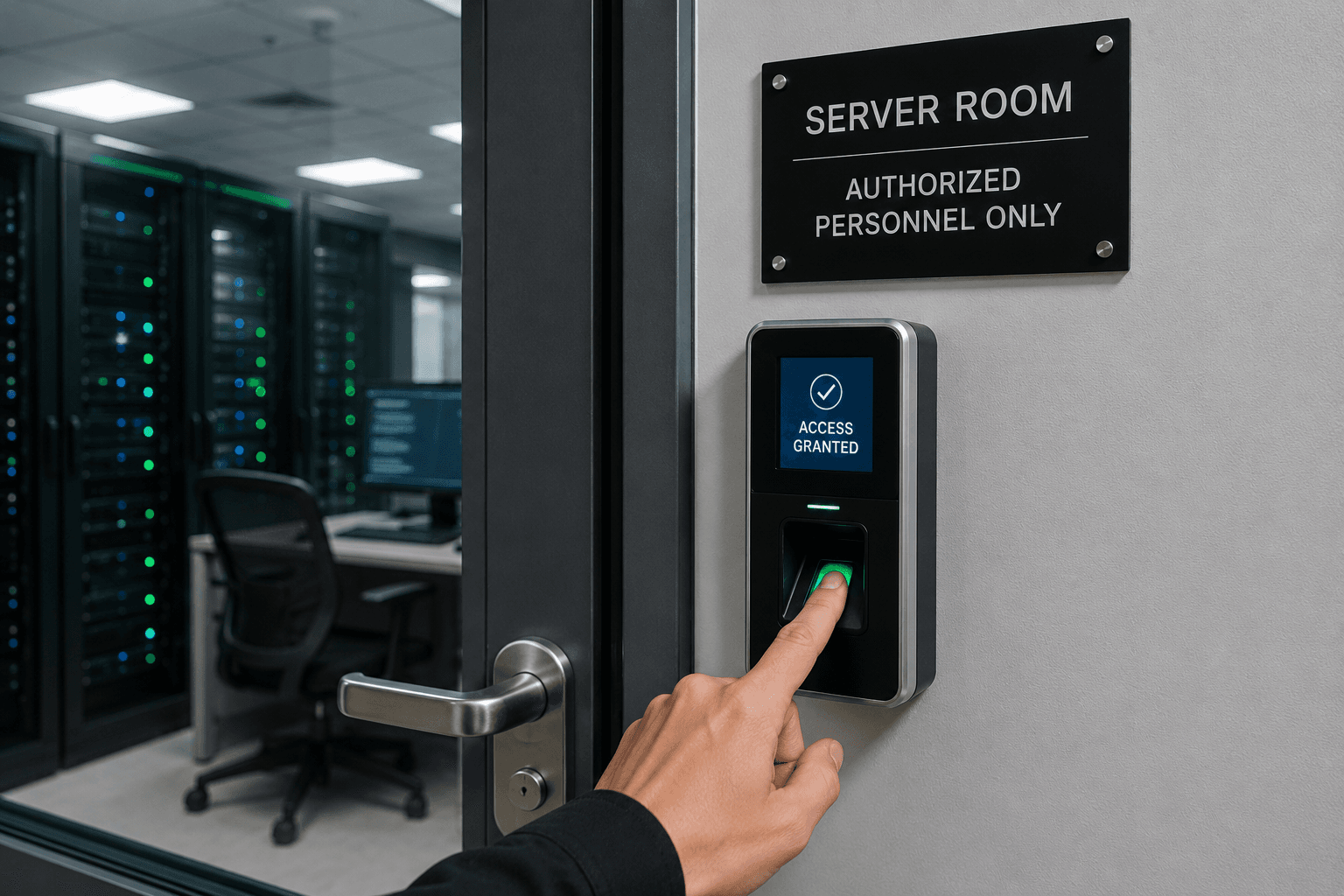
Biometric access control uses a physical characteristic — most commonly a fingerprint or facial scan — instead of a badge or fob to verify identity at a controlled entry point, and it's best suited for Sacramento facilities where credential sharing or lost badges pose a real security risk, such as server rooms, pharmacies, and other high-security areas.
How Biometric Access Control Differs from Badge-Based Systems
A badge or fob proves that someone has a credential — it doesn't prove that the person using it is the person it was issued to. Badges get shared between coworkers, lost, or occasionally cloned. Biometric credentials tie access directly to a physical characteristic that can't be handed off, which closes that gap for the specific doors where identity verification actually matters.
Where Biometric Access Control Makes Sense
- Server rooms and IT infrastructure — restricting access to a small, verified group with no risk of a shared badge.
- Pharmacies and controlled substance storage — regulatory and liability reasons to know exactly who accessed a restricted area.
- Executive and finance offices — protecting sensitive records and financial systems from unauthorized internal access.
- Research and laboratory facilities — controlling access to equipment or materials that require a verified chain of custody.
Biometric readers are typically deployed selectively at these higher-risk doors rather than replacing every credential in a building — see our access control services for how this is scoped.
Is Biometric Access Control Overkill for Most Businesses?
For a standard office suite or retail entrance, badge-based access control is usually sufficient — the operational simplicity outweighs the marginal security benefit of biometrics. Biometric access control earns its cost at the specific doors where the consequence of a shared or misused credential is significant, which is why most Sacramento deployments combine both: badges for general building access, biometrics layered on top for the handful of doors that actually need it.
Privacy and Data Handling Considerations
Biometric data requires careful handling — the National Institute of Standards and Technology (NIST) publishes guidance on biometric data security that reputable access control vendors follow, including how templates are stored and encrypted rather than kept as raw, reversible images. Asking a potential installer how biometric data is stored and secured is a reasonable question before moving forward with a deployment.
Getting Started
A biometric access control deployment starts with identifying which doors actually need it, not a blanket building-wide rollout. Our team walks Sacramento facilities through that assessment as part of a standard access control consultation.
FAQ
Is biometric access control more expensive than badge-based systems?
Per door, yes — biometric readers cost more than standard card readers, which is why most facilities deploy them selectively at high-security doors rather than throughout the building.
What happens if a biometric reader fails to recognize someone?
Most systems support a backup credential method, such as a PIN or badge, so a single failed scan doesn't lock an authorized person out.
Is biometric data stored securely?
Reputable systems store an encrypted mathematical template of the biometric data rather than a reversible image, following data security guidance from bodies like NIST.
Can biometric access control be added to an existing badge-based system?
Yes — biometric readers are commonly layered onto an existing access control platform at specific doors, rather than replacing the entire system.
Curious whether biometric access control fits your Sacramento facility? Talk to a Security Specialist Today.