
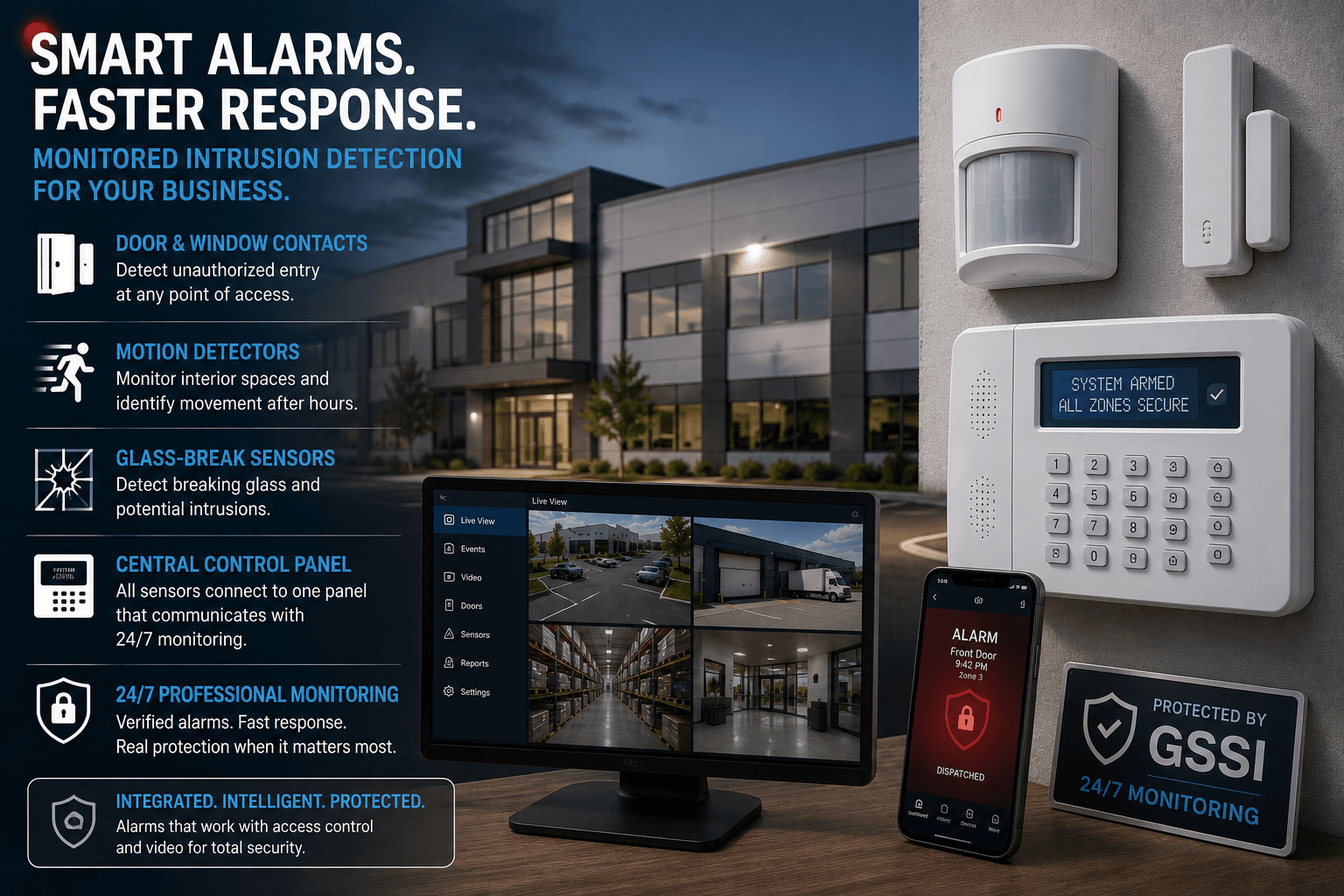
A modern business alarm system is built around monitored intrusion detection — door and window contacts, motion sensors, and a central panel that reports directly to a monitoring service — designed to trigger a fast, verified response rather than simply making noise after a break-in has already happened.
What a Modern Business Alarm System Includes
Commercial intrusion detection typically combines several sensor types working together: door and window contacts that flag forced or unauthorized entry, motion sensors covering interior spaces after hours, and glass-break detection for storefronts and ground-floor windows. All of it reports to a central panel, which communicates with a monitoring center — so an alarm event triggers a real response, not just a loud noise that may or may not be heard.
How Commercial Intrusion Detection Differs from Residential Alarms
Commercial facilities carry different risks than a house — larger footprints, multiple entry points, shift-based occupancy, and often higher-value inventory or equipment. A commercial-grade system is built to handle zoned coverage across a much larger property, integration with other business systems, and monitoring protocols suited to a facility that may be unoccupied for stretches of time — rather than a residential system scaled up to fit a commercial space.
Integrating Alarms with Access Control and Video Surveillance
Intrusion detection is most effective as part of an integrated platform. Paired with access control, the alarm system can automatically arm when the last authorized credential exits the building and disarm when the first one arrives — removing the human error of someone forgetting to set the alarm. Paired with video surveillance, an alarm trigger can pull up live camera footage immediately, giving a monitoring team the ability to verify an actual intrusion versus a false alarm before dispatching a response.
What Happens When an Alarm Is Triggered
When a sensor is tripped, the panel sends a signal to the monitoring center, which verifies the event — often by pulling associated video — before contacting the business and, if warranted, local authorities. That verification step matters: it's the difference between a fast, accurate response and either a missed break-in or an unnecessary dispatch. According to the Insurance Information Institute, monitored commercial alarm systems remain one of the most effective tools for reducing loss from break-ins, both by deterring intrusion and by shortening response time when one occurs.
Choosing the Right Intrusion Detection Partner
Intrusion detection works best as part of a system designed around the specific facility — sensor placement, zoning, and monitoring protocols should reflect how the business actually operates, not a standardized package applied to every property. Learn more about how we approach system design on our why choose us page, or see the full picture on our intrusion detection services page.
FAQ
Is a business alarm system the same as a residential one, just bigger?
No. Commercial intrusion detection is designed for larger footprints, multiple entry points, and integration with other business systems — it's built differently from the ground up, not scaled up from a residential product.
What happens after an alarm is triggered?
The monitoring center verifies the event, often using integrated video, before contacting the business and dispatching a response if warranted.
Can intrusion detection integrate with our existing access control or cameras?
In most cases, yes — integration is assessed as part of a site consultation and depends on the existing systems in place.
How quickly can a business alarm system be installed?
Timelines depend on the facility's size and existing infrastructure, and are scoped during the initial site assessment.
Want to know what integrated intrusion detection would look like for your facility? Talk to a Security Specialist Today.