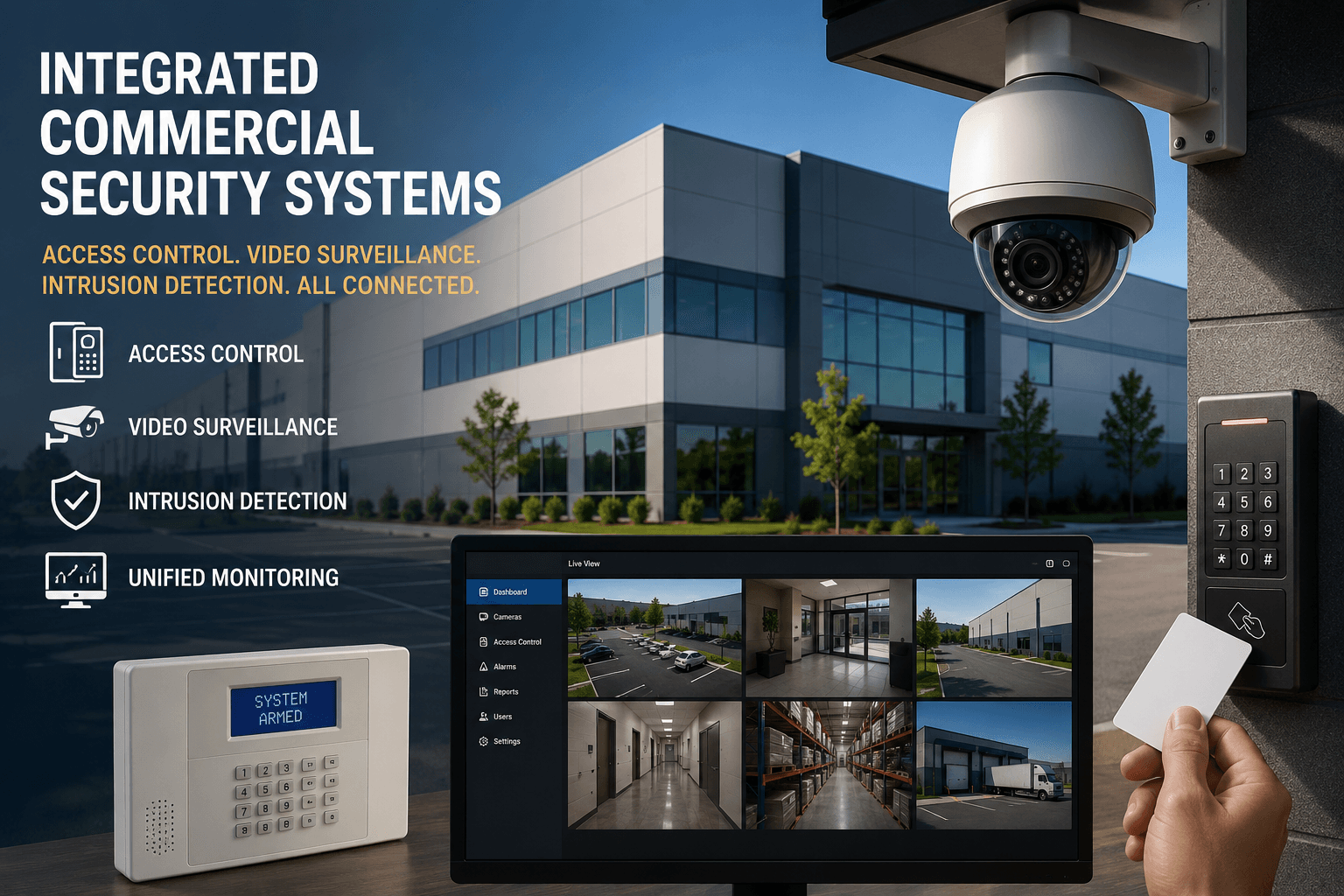
A commercial security system for a Lodi business typically integrates access control, IP video surveillance, and intrusion detection into a single managed platform — designed around the facility's layout, risk profile, and operational needs, rather than assembled from disconnected components purchased off a shelf.
Why Central Valley Businesses Need an Integrated Approach
Warehouses, distribution centers, medical offices, and retail properties across Lodi and the surrounding Central Valley each carry a different risk profile: after-hours break-ins, employee credential misuse, cargo theft, or liability exposure from an unmonitored entrance. A standalone camera or a single door lock addresses one piece of that picture. An integrated system — where access events, video, and alarm activity all live on one platform — gives ownership and management a complete, real-time view of what's happening across the property, and a verifiable record when something goes wrong.
The Core Components of a Commercial Security System
- Access control systems — credentialed entry at exterior doors, server rooms, and restricted areas, with a full audit trail of who entered where and when. See our access control services for how this is typically deployed.
- IP video surveillance — high-resolution cameras covering entrances, parking areas, and interior chokepoints, with remote viewing and extended retention. More detail on our video surveillance page.
- Intrusion detection — motion sensors, door/window contacts, and monitored alarm panels that trigger an immediate response outside business hours. Covered in depth on our intrusion detection page.
- Unified monitoring — all three systems reporting into one managed platform, rather than three separate logins and three separate vendors to coordinate during an incident.
What to Look for in a Security System Integrator
Not every installer designs systems the same way. Look for:
- A licensed C-7 electrical contractor — low-voltage security work involves real electrical and structural considerations, and licensing matters for both code compliance and long-term reliability.
- A vendor-agnostic approach — an integrator who isn't locked into one manufacturer can match hardware to your facility instead of your facility to their preferred product line.
- Local, regional knowledge — a team familiar with San Joaquin County permitting and the practical realities of Central Valley facilities, from ag operations to logistics hubs.
- Design-through-support continuity — the same team handling design, installation, programming, and ongoing support avoids the finger-pointing that happens when multiple vendors are involved.
Designing a System Around Your Facility's Risk Profile
There's no single system that fits every Lodi business. A cold storage facility has different access and monitoring needs than a professional office or a retail storefront. A properly designed system starts with a walk-through of the physical property, an assessment of existing infrastructure, and a conversation about what's actually being protected — inventory, equipment, employee safety, or all three. That assessment then drives decisions about camera placement, door hardware, and how the intrusion detection zones are configured. Our industries served page outlines how this plays out across different business types.
Getting Started: What a Site Consultation Looks Like
A site consultation is a walkthrough, not a sales pitch — an integrator evaluates entry points, existing wiring, and coverage gaps, then proposes a system scoped to the property rather than a generic package. For businesses in Lodi, Stockton, and the broader San Joaquin County area, our areas served page covers current coverage. According to the Security Industry Association, integrated, professionally installed systems consistently outperform piecemeal setups on both reliability and incident response time — a gap that tends to show up exactly when a business can least afford it.
FAQ
What's included in a typical commercial security system?
Most Central Valley commercial systems combine access control at key entry points, IP video surveillance covering the perimeter and interior chokepoints, and monitored intrusion detection — all integrated into one platform rather than managed as separate tools.
How long does installation take for a mid-size facility?
It depends on the number of doors, cameras, and the condition of existing wiring, but most projects move from site assessment to a scoped proposal within a matter of days, with installation timelines set during that consultation.
Do you work with businesses outside Lodi?
Yes — Golden State Security Integrations serves businesses across San Joaquin County, including Stockton, and the broader Central Valley to Bay Area region. See our areas served page for details.
Is a licensed contractor really necessary for security system installation?
Yes. Security system wiring and installation intersects with electrical code, and working with a licensed C-7 contractor protects the business from compliance issues and rework down the line. You can verify any contractor's license status through the California Contractors State License Board.
Ready to see what an integrated system would look like for your facility? Request a Free Security Assessment and our team will walk the property with you.