
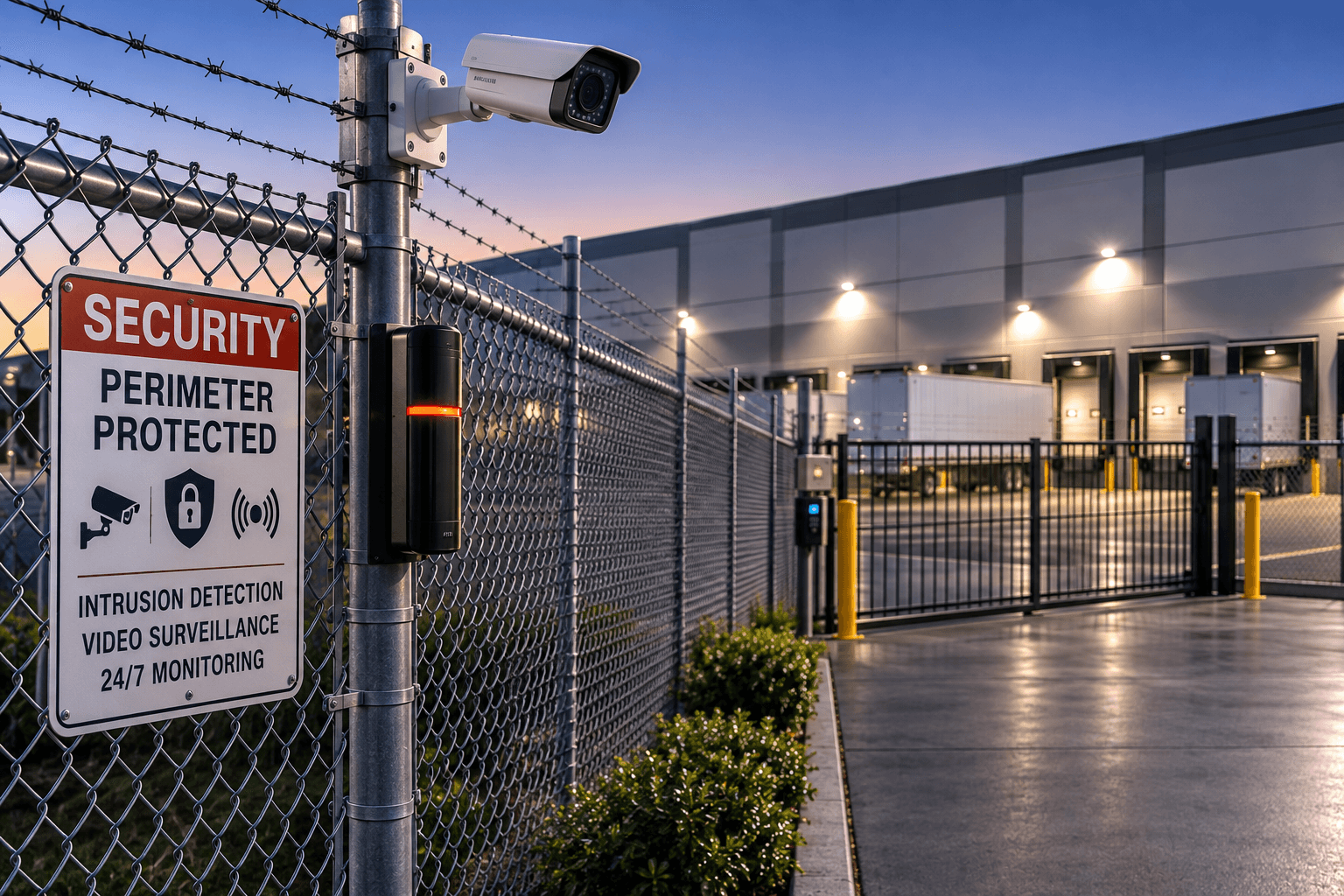
Perimeter alarm systems for Sacramento warehouses and industrial sites are designed to detect an intrusion at the property's outer boundary — fencing, gates, loading dock doors, and yard areas — before someone reaches the building itself, giving a facility earlier warning than interior sensors alone.
Why Interior Alarms Alone Aren't Enough for Industrial Properties
A standard intrusion detection setup covers doors and windows on the building itself, which means the alert only triggers once someone has already reached the structure. For a warehouse or industrial site with a large outdoor footprint — yard equipment, trailers, loading docks, and stored materials — that's often too late. Perimeter alarm systems extend detection to the property boundary, catching activity while it's still outside the building.
Perimeter Detection Technologies
- Fence-mounted sensors — detect climbing, cutting, or tampering along a perimeter fence line.
- Gate and vehicle entry sensors — monitor vehicle and pedestrian access points separately from the main building.
- Outdoor motion and infrared detection — cover open yard space where fencing alone isn't practical.
- Loading dock sensors — a common vulnerability point on industrial properties, monitored separately from standard door contacts.
These typically integrate with a facility's broader intrusion detection system rather than operating as a standalone product.
Combining Perimeter Alarms with Video Verification
A perimeter sensor alone tells a monitoring center that something triggered a zone — it doesn't say what. Pairing perimeter detection with video surveillance at the same boundary points allows an alarm event to be visually verified in real time, which reduces false-alarm dispatches and gives responding personnel or law enforcement an actual description of what's happening rather than just a zone number.
What This Looks Like for Central Valley Industrial Sites
Warehouses, distribution centers, and industrial yards across the Sacramento Valley often carry significant equipment and inventory value sitting in outdoor or semi-outdoor areas — exactly the exposure perimeter detection is designed to address. According to the Insurance Information Institute, commercial property theft and vandalism losses are disproportionately concentrated at facilities with unmonitored outdoor storage and yard areas, which is why insurers increasingly ask about perimeter security as part of commercial policy underwriting.
Designing a Perimeter System Around Your Property
Perimeter alarm design starts with the property's actual layout — fence lines, gate locations, lighting, and existing camera coverage — rather than a generic sensor package. A site walkthrough identifies where sensors and cameras are actually needed versus where existing infrastructure already provides adequate coverage. See our industries served page for how this varies across warehouse, logistics, and manufacturing properties.
FAQ
What's the difference between perimeter and interior intrusion detection?
Perimeter detection covers the property boundary — fencing, gates, and yard areas — while interior detection covers the building itself. Industrial sites typically need both.
Does a perimeter alarm system reduce false alarms?
When paired with video verification, yes — a monitoring center can visually confirm an event before dispatching a response, rather than escalating on a sensor trigger alone.
Can perimeter alarms be added to an existing intrusion detection system?
Yes, perimeter sensors are typically integrated into a facility's existing alarm platform rather than run as a separate system.
Does insurance ever factor in perimeter security?
Some commercial property insurers do consider perimeter security measures during underwriting, particularly for facilities with significant outdoor equipment or inventory exposure.
Have a warehouse or industrial site with unprotected outdoor areas? Request a Free Security Assessment to see where perimeter coverage is needed.