Choosing business security cameras in Lodi comes down to three things: coverage that matches the property's actual risk points, IP camera hardware suited to lighting and distance conditions on site, and integration with the rest of the security platform — not simply the number of cameras installed.
Why IP Cameras Have Replaced Analog Systems
Older analog camera systems are limited by resolution, cabling distance, and how footage is stored and retrieved. Modern IP camera installation runs over standard network infrastructure, delivers far higher resolution for identifying faces, license plates, and incident details, and allows remote viewing from a phone or laptop rather than requiring someone on-site to pull footage from a physical recorder. For a Lodi business handling inventory, cash, or high-value equipment, that difference in image clarity is often what makes footage usable as evidence rather than just a grainy record that something happened.
Key Factors in Designing a Video Surveillance System
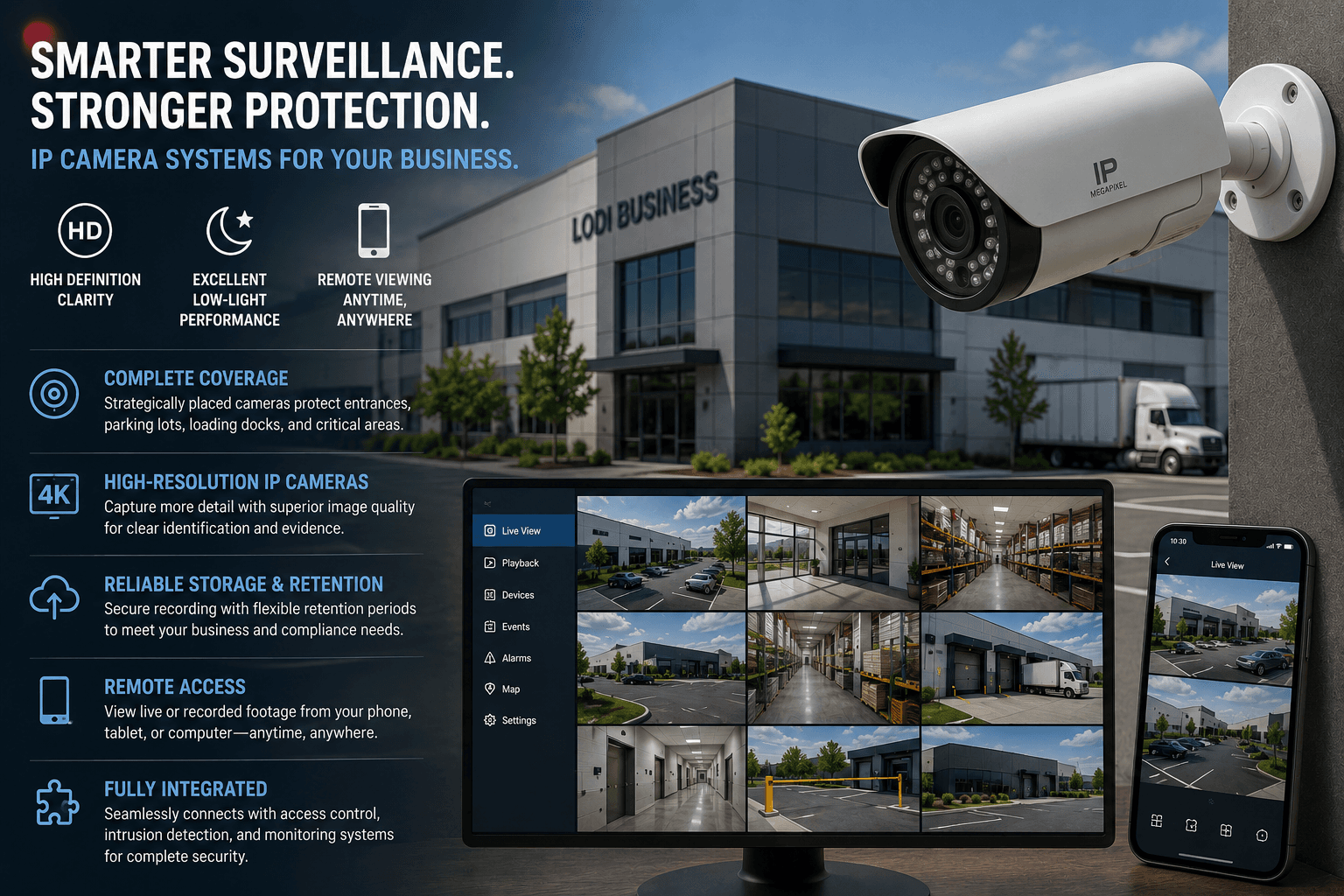
- Coverage — entrances, exits, parking areas, loading docks, and any interior chokepoints where inventory or cash changes hands.
- Resolution and low-light performance — critical for exterior cameras covering nighttime hours, when most break-ins occur.
- Storage and retention — how long footage needs to be retained depends on the business type and any insurance or compliance requirements.
- Remote access — the ability for ownership or management to check live or recorded footage from anywhere, without being tied to an on-site recorder.
What IP Camera Installation Actually Involves
A properly scoped installation starts with a walk of the property to identify blind spots and priority areas, followed by a design that accounts for cabling runs, power (often Power over Ethernet), and network capacity. This is where working with an experienced security system integrator matters — camera placement decided without that assessment tends to leave gaps at exactly the points that matter most.
Integrating Cameras with Access Control and Monitoring
Video surveillance delivers the most value when it's tied to other systems rather than reviewed in isolation. Paired with access control, footage can be pulled automatically around a specific badge event. Paired with monitored intrusion detection, an alarm trigger can pull up live video instantly, so a monitoring team — or the business owner — knows what's actually happening before dispatching a response.
Temporary Coverage for Construction and Special Sites
Not every security need is permanent. For construction sites, seasonal operations, or special events, security camera trailers provide surveillance coverage without a permanent installation — a common need for Central Valley properties during ag season builds or active job sites. Insurers and loss-prevention groups, including the National Insurance Crime Bureau, consistently point to visible video monitoring as one of the more effective deterrents against theft on active job sites.
FAQ
How many cameras does a typical commercial property need?
It depends entirely on the property's size, layout, and risk points — a site walkthrough is the only reliable way to determine coverage, rather than a fixed number applied to every business.
Can footage be viewed remotely?
Yes, IP camera systems typically allow live and recorded footage to be viewed from a phone, tablet, or computer, from anywhere with an internet connection.
Do you offer temporary camera coverage for construction sites?
Yes — our security camera trailer service is designed for exactly this, providing surveillance without a permanent install.
How long is footage typically retained?
Retention periods vary by business type and any applicable insurance or compliance requirements, and are configured as part of the system design.
Ready to map out camera coverage for your property? Get a Custom Security Quote and our team will walk the site with you.