
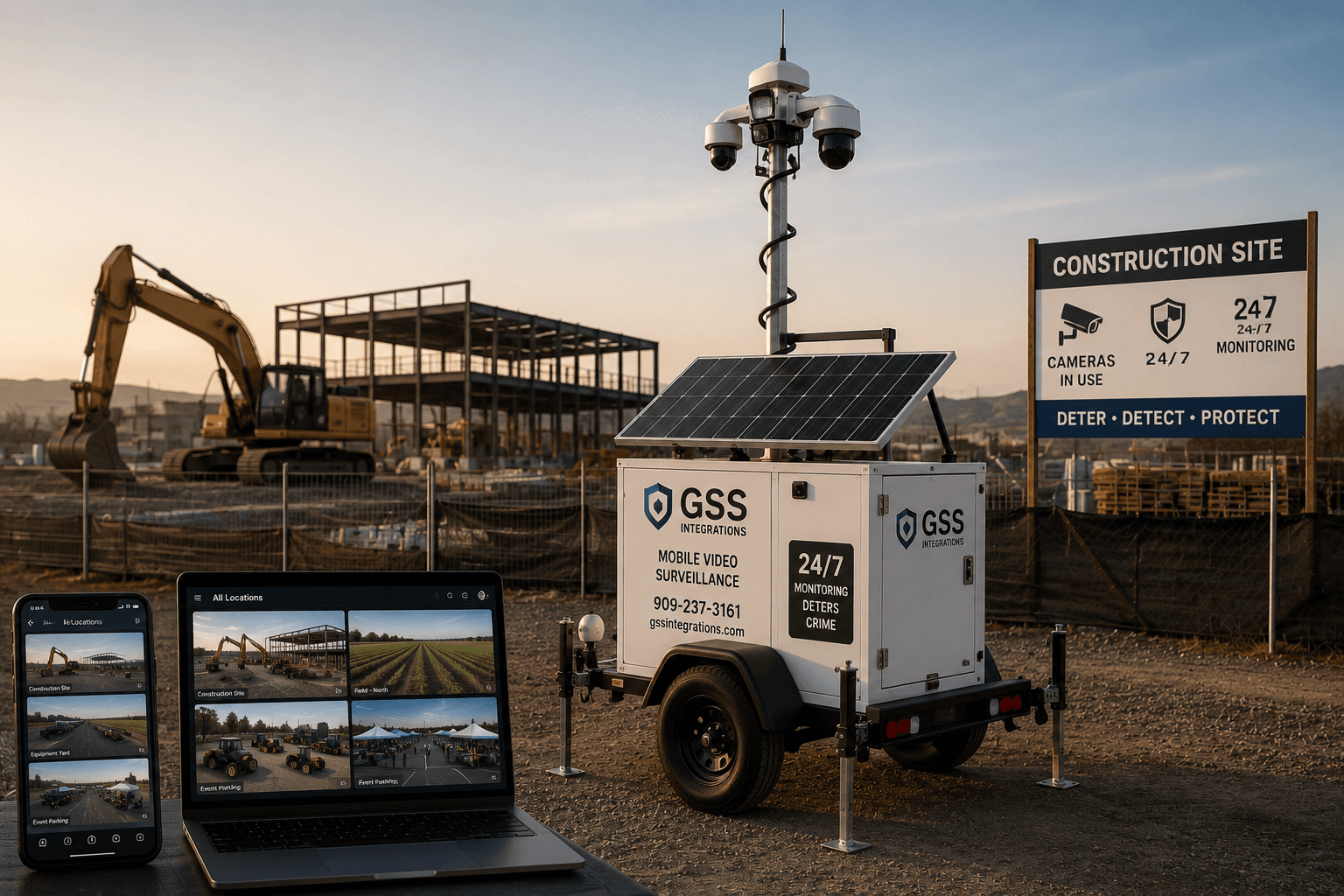
Security camera trailers provide mobile, self-contained video surveillance — typically solar-powered with an elevated camera mast and cellular connectivity — for sites that need coverage temporarily rather than a permanent installation, such as active construction sites, agricultural operations, or special events.
When a Permanent Camera System Isn't the Right Fit
Not every site that needs surveillance is a fixed, ongoing property. A construction project has a defined timeline. A harvest season creates a temporary spike in equipment and material sitting out in the open. A special event needs coverage for a few days, not years. In each of these cases, running permanent wiring and mounting fixed cameras doesn't make sense — the coverage need disappears once the project, season, or event ends.
How Security Camera Trailers Work
A camera trailer is a self-contained unit — cameras, a mast, solar power, and cellular connectivity all built into one mobile platform — that can be positioned wherever coverage is needed and relocated as a site's layout changes. Because it doesn't rely on a facility's existing power or network infrastructure, it can be deployed on raw land, an active job site, or anywhere else a fixed installation would be impractical. Footage is typically viewable remotely, the same as a permanent IP camera system. See our security camera trailer service for how these are deployed.
Common Uses: Construction, Agriculture, and Special Events
- Construction sites — deterring theft of tools, materials, and equipment during active builds, when a site is most exposed.
- Agricultural operations — covering equipment, storage areas, and remote parcels during harvest or peak-season activity across the Central Valley.
- Special events — temporary coverage for gatherings, fairs, or large parking areas where security needs spike for a limited window.
What to Look for in a Camera Trailer Provider
Trailer quality varies. Look for solar power that's actually sufficient for continuous operation (not just supplemental), cellular connectivity that doesn't depend on a nearby facility's Wi-Fi, and remote monitoring access rather than footage that only gets reviewed after something has already happened. Construction and equipment theft groups, including the National Insurance Crime Bureau, consistently identify visible, actively monitored camera coverage — not just recorded footage — as one of the most effective deterrents on active job sites.
Transitioning from Temporary to Permanent Coverage
Camera trailers and permanent systems aren't mutually exclusive — a construction site that becomes an operating facility, for example, often transitions from trailer coverage during the build to a permanent video surveillance installation once the property is occupied. Planning that transition with the same integrator avoids gaps in coverage and duplicated design work between the temporary and permanent phases.
FAQ
How long can a security camera trailer stay on site?
As long as the project or need requires — trailers are commonly deployed for the duration of a construction project, a full growing season, or just a few days for an event.
Do camera trailers need access to power or internet on site?
No — they're self-contained, with solar power and cellular connectivity built in, so they can be deployed on sites without existing infrastructure.
Can footage from a camera trailer be viewed remotely, like a permanent system?
Yes, footage is typically viewable live and on playback from a phone or computer, the same as a standard IP camera installation.
What happens when the temporary need ends?
The trailer is relocated to the next site, or if the property is transitioning to a permanent operation, the coverage can be planned into a fixed video surveillance installation.
Need temporary coverage for a job site, harvest season, or event? Talk to a Security Specialist Today about deploying a camera trailer.