
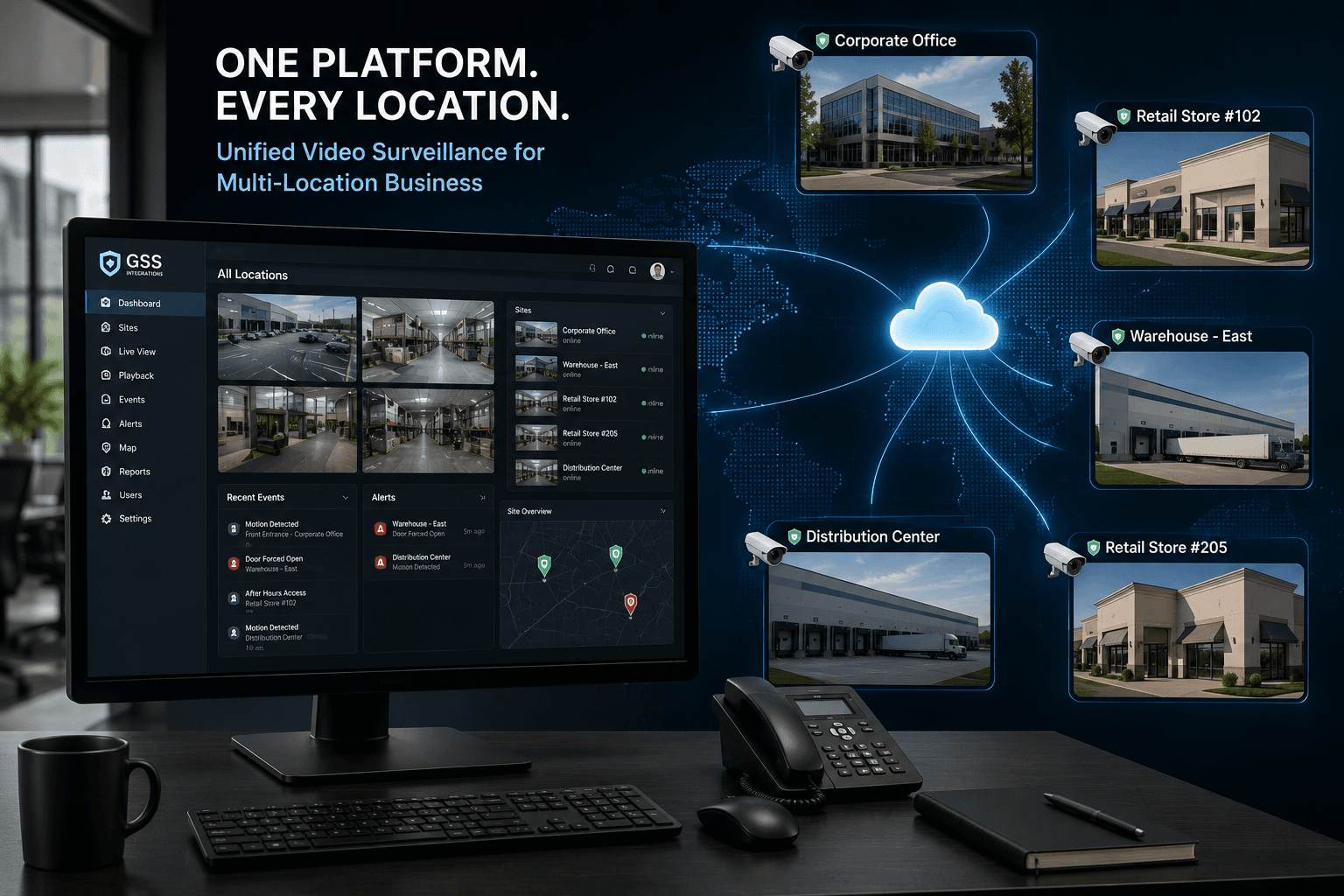
Video surveillance installation for a multi-location business works best when every site reports into one unified platform — rather than a separate camera system, login, and storage setup at each property — so ownership can view, manage, and pull footage from any location without contacting a different vendor for each one.
The Challenge of Securing Multiple Sites Separately
Businesses that grow from a single location to several often end up with a patchwork of camera systems — different equipment, different software, sometimes different installers — simply because each site was set up at a different point in time. That patchwork creates real operational drag: management has to log into multiple platforms to check on different properties, footage retention and quality vary site to site, and there's no consistent way to compare incidents or coverage across the business.
What a Unified Video Platform Actually Provides
- Single login, all locations — live and recorded footage from every site accessible from one dashboard.
- Consistent coverage standards — the same camera quality, placement logic, and retention policy applied across every property, not just the newest one.
- Centralized alerts — motion or access events from any location surfaced in one place, rather than requiring someone to check each site individually.
- Simplified vendor management — one integrator responsible for design, installation, and support across the whole portfolio.
Standardizing Camera Systems Across Locations
Standardization doesn't mean every site gets an identical camera count — a smaller satellite office and a large distribution hub have different coverage needs. It means every site is designed against the same standards for resolution, retention, and platform compatibility, so footage and access work the same way no matter which property someone is looking at. Our video surveillance services page covers how this is typically scoped per property within a larger rollout.
Integrating Multi-Site Video with Access Control and Alarms
The same unification applies to access control and intrusion detection — when all three systems report into one platform across every location, an unusual access event or alarm trigger at any site surfaces in the same place video does, rather than requiring separate checks across separate systems. According to the Security Industry Association, unified security platforms are one of the fastest-growing priorities among multi-site commercial operators, largely because fragmented systems create both security gaps and unnecessary management overhead.
Rolling Out Installation Without Disrupting Operations
A multi-site rollout is typically phased — site by site or region by region — so operations continue uninterrupted at each property while the system is standardized across the portfolio. This also allows lessons from the first site's installation to improve the process at the next one, rather than repeating the same coordination challenges at every location independently.
FAQ
Do all our locations need identical camera systems?
No — coverage is scoped to each site's size and layout, but every location should be built to the same platform, resolution, and retention standards so management works consistently across the portfolio.
Can we bring existing camera systems at some locations into a unified platform?
In many cases, yes, depending on the existing equipment and platform. This is assessed on a site-by-site basis during the initial consultation.
How is a multi-location rollout typically sequenced?
Most rollouts are phased by site or region so operations aren't disrupted, with each installation informed by what worked at the previous one.
Does a unified platform also cover access control and alarms, or just video?
It can cover all three — video, access control, and intrusion detection — reporting into the same platform across every location, which is where most of the operational benefit comes from.
Managing security across more than one location? Schedule Your Site Consultation and we'll map out what unifying your properties would look like.